Features
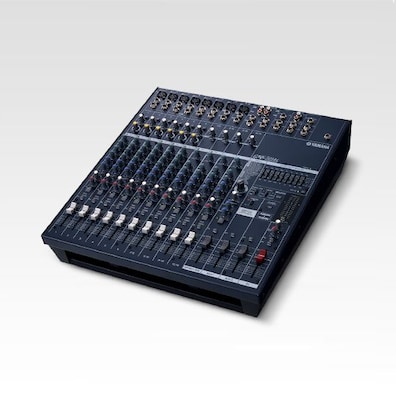
12-bus format
This allows 10 individual monitor mixes and 2 auxiliary mixes.
4-band EQ
With fixed high and low and two swept mids.
Switchable hi-pass filter
The filter is located on each input channel (80 Hz roll-off).
4 auxiliary return channels
Electronically-balanced XLR connections
These are for the microphone inputs and group outputs.
48 V phantom powering
The powering is for the condenser microphones.
Input channel pad switch (20 dB)
Input channel phase reverse switch
Insert patch points
The points are on all the input channels and group outputs.
Groups 9 and 10
These can be used to create a stereo mix.
Large, illuminated VU meters with integral peak LED
Low noise, high rejection integral power supply
Rugged chassis construction
The construction is for long-term touring reliability.
Noise Immunity
In all mixing consoles, both stage and studio, the 2 areas most vulnerable to external hum fields, RF noise, etc. are the head preamp and bus lines. By applying newly available technology and reconsidering the "old school" console design basics, the Yamaha design team have managed to provide these 2 areas with total immunity. In fact, placing a console on top of a high-powered amp. will not increase the system noise that much, even with the power amp's massive transformer.
Auxiliaries
Two post-EQ auxiliary sends are available on each input channel. Two master auxiliary send controls are provided, each with a cue switch. Four return inputs, each with level, cue, and routing switches, can be used as auxiliary effect returns, tape inputs, or for inputting any line level signals that do not require all the facilities of a standard input channel.
Technology
Audio & Video
Specs
Specifications
| Frequency Response | 20 Hz ~ 20 kHz +1 , -3 dB @ +4 dB into 600 ohm | |
|---|---|---|
| THD | <0.1% 20 Hz ~ 20 kHz @ +14 dB into 600 ohm | |
| Equivalent Input Noise | -128 dB | |
| Residual Noise | -97 dB | |
| Output Noise | Group Out 1~8: -80 dB Group fader nominal *1, all input volumes minimum -66 dB Group fader nominal *1, 1 input volume nominal. Group Out 9/L, 10/R: -80 dB Group fader nominal *1, all input volumes minimum. -70 dB Group fader nominal *1, 1 input volume nominal. Aux Out : -82 dB Aux out control nominal *1, all input channel Aux controls off. -66 dB Aux control nominal *1, 1 input channel Aux control nominal. | |
| Maximum Voltage Gain | Ch In to Group Out: 80 dB Ch In to Aux Out: 76 dB Ch In to Ch Insert: 60 dB Returns to Group Out: 16 dB Talkback In to Group Out: 70 dB Sub In to Group Out: 10 dB Cue Sub In to Cue Out: 6 dB | |
| Input Gain Control Range | 44dB variable | |
| Input Phase Switch | Normal/ reverse | |
| Input PAD Switch | 0/20 dB | |
| Input High Pass Filter | 80 Hz roll off, 12 dB/octave | |
| EQ Characteristics | High EQ: 15 dB max @ 10 kHz *2 shelving: High Mid EQ: 15 dB max @ 400 ~ 8 kHz peaking Low Mid EQ: 15 dB max @ 80 ~ 1.6 kHz peaking Low EQ : 15 dB max @ 100 Hz *2 shelving | |
| Crosstalk | Adjacent input channels: -70dB @ kHz Input to output: -70 dB @ 1 kHz | |
| CH Peak Indicator | Illuminates 3 dB below clipping (post EQ) | |
| Cue Signal Indicator | Illuminates when a signal 20 dB below the nominal level is present on the cue bus. | |
| VU Meters | OVU = +4 dB, Peak LED illuminates 3 dB below clipping. | |
| Phantom Power Supply | +48 V DC | |
| Power Requirements | U. S. and Canadian models: 120 V (105 V ~ 130 V), 60 Hz General Model: 230 V 15% (220 V ~ 240 V), 50 Hz | |
| Power Consumption | U.S. and Canadian models: 80 W General model: 80 W | |
| Dimensions (W x H x D) | 1204 x 185 x 739 mm (47-3/8" x 7-1/4" x 29-1/8") | |
| Weight | 38 kg (84 lbs.) | |