
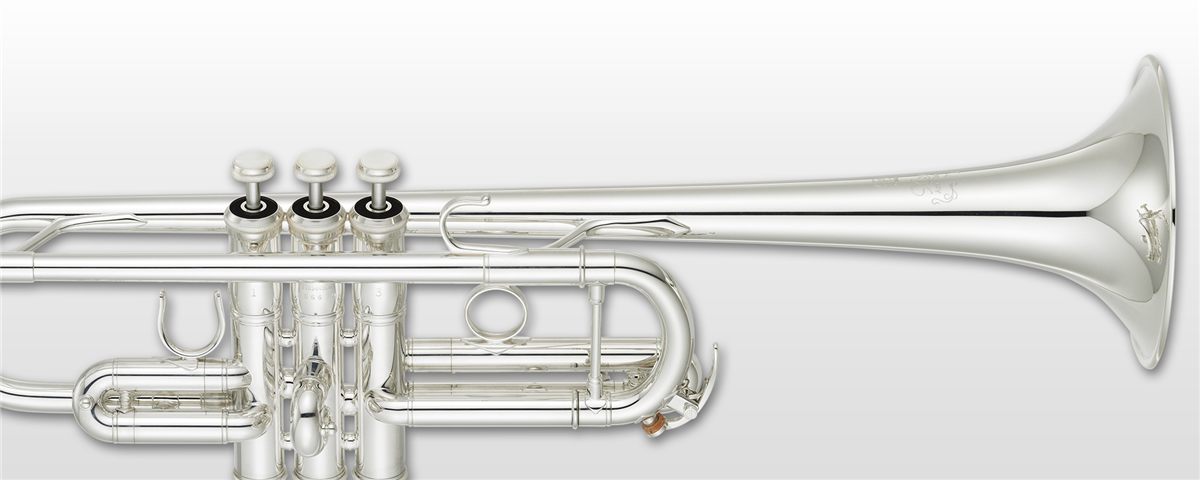
Artistic guidance was provided during the design stage by John Hagstrom of the Chicago Symphony Orchestra. We focused on achieving the ideal resistance and weight balance, and we re-thought every part of the new Chicago model. We've created an instrument that is not simply easy to play, but also provides a delicate response when playing soft and a powerful presence when playing loud . Every component of the instrument contains the input of artists from around the world, allowing us to create a highly evolved Chicago model.
Features
Developed with John Hagstrom
The consultant for the Chicago model is John Hagstrom, a member of the Chicago Symphony Orchestra and an outstanding soloist.
John Hagstrom is a member of the Chicago Symphony Orchestra's famous trumpet section (since 1996). He is also in constant de...
Features
Developed with John Hagstrom

The consultant for the Chicago model is John Hagstrom, a member of the Chicago Symphony Orchestra and an outstanding soloist. John Hagstrom is a member of the Chicago Symphony Orchestra's famous trumpet section (since 1996). He is also in constant demand as both a trumpet teacher and trumpet soloist around the world. Prior to joining the Chicago Symphony Orchestra, he had been the principal trumpet with the Wichita Symphony Orchestra and "The President's Own" United States Marine Band, in Washington, DC. Hagstrom is passionate in his support of music education, and helped to initiate Dream Out Loud, a music education advocacy partnership between the Chicago Symphony Orchestra Association and the Yamaha Corporation of America. Dream Out Loud offers a variety of resources created for elementary through high school students, their teachers and parents, designed to support every student’s interest in playing an instrument, and providing encouragement through times of challenge. To learn more about Dream Out Loud, visit cso.org/dreamoutloud John Hagstrom has also worked extensively with Yamaha to create several professional trumpet designs in their Chicago Artist Model Series that include top selling Bb and C trumpets. Since its introduction in 2004, the Chicago Artist Model C Trumpet has been the instrument played most often by players winning orchestral positions in major U.S. orchestras. Due to its phenomenal commercial and artistic success worldwide, in 2006 Yamaha selected the Chicago Artist Model C Trumpet to be their 10 millionth instrument ever produced. A native Chicagoan, Hagstrom grew up listening to the CSO. Five years of study at the Eastman School of Music were followed by six years in “The President's Own” United States Marine Band in Washington, D.C., where he spent three of those years as principal trumpet. His many solo appearances with the band included four national concert tours and the Camp David wedding of (Sr.) President Bush's daughter, Dorothy. Recordings featuring John Hagstrom include his performance of the Bellini Oboe Concerto and the Sachse Concertino with the Chicago Brass Choir, and can also be heard as lead trumpet on Daniel Barenboim's recording on the Teldec label entitled Tribute to Ellington. In June of 2006 his first solo CD (with the DePaul University Wind ensemble under the direction of Donald DeRoche) was released on the Albany Records label, about which Time Out Chicago said: “You'd never guess he was a mild-mannered second trumpeter from the hair-raising high notes... or from the way he seamlessly unfurls long lines” (TimeOut.com).
New bell design

The newly designed bell is narrower toward the pistons and has a squared-corner, U-shaped crook that provides the performer with optimal resistance. This results in a richer sound with a strong tonal core that improves upper register playability. The wall thickness gradually tapers, thinning as it gets closer to the rim. The flat rim helps hold sound together even at extreme dynamic ranges.
Leadpipe


Utilizing an original Malone Pipe™ (MC1) for a leadpipe and a shallower mouthpiece receiver, we've achieved improved tone and response while providing the performer with optimal resistance characteristics. Malone Pipe™ is based on leadpipes designed by renowned brass instrument artisan Bob Malone, the Malone Pipe™ is available in several keys, offering quick response, superior intonation and unparalleled evenness of tone. Originally a trumpet player himself, Bob Malone opened his own custom brass shop in Los Angeles in 1983. Trumpeters flocked to his shop to have him personally customize their horns. His original leadpipe design has enjoyed wide acclaim and is still held in high regard among trumpet players. Since Bob joined Yamaha’s Research and Development team in 2001, his Malone Pipe™ design has made its way into a number of Xeno Artist models and Custom series instruments. Rich and brilliant tone with excellent projection, the Malone Pipe™ brings total expression to your music.
Improved response and ideal blowing resistance

Redesigned parts, such as lighter weight pistons and valve casing, a semi-square crook shaped tuning slide and water key spring, result in improved response and provide the performer with optimal resistance characteristics.
The first valve slide

The first valve slide features a special brace which gives a stronger focus to the core of the tone for unparalleled definition and clarity.
The 3rd valve slide stopper

The 3rd valve slide stopper has been moved to allow extended slide play for a low F or to facilitate alternative fingerings. The stopper button has been reduced to a standard-size to reduce weight and increase resonance.
Slide stopper

The slide stopper is used to prevent the trumpet slides from coming off the instrument. The slide stopper is made of silicone rubber, which does not discolor the instruments finish like regular rubber does. It can be left in place while playing. (Size: M, Length: 12 cm)
Case

New TRC-800E double case with a strap.
Technology
Development Story
More than 40 years have passed since Yamaha began manufacturing wind instruments, but the passion for innovation and drive for perfection has remained the same. The following are comments by Yamaha staff, in commemoration of the 20th anniversary of Xeno.
-
Director & Managing Executive Officer of Yamaha Corporation who used to be a designer and laid the foundation for Yamaha Trumpets. Hiroo Okabe
«View Comment -
A designer since the beginning of Yamaha trumpet manufacturing, he was the originator of the idea to use the name of “Xeno”. Kenzo Kawasaki
«View Comment -
A designer who has been involved in the Xeno series development since he joined Yamaha. Shunichi Niwata
«View Comment -
Designer of industry leading trumpets including the Xeno Artist Model. Norihisa Fukuda
«View Comment -
The present designer of trumpets including the Xeno 20th anniversary model, YTR-8335RS20TH. Katsuhiko Furumi
«View Comment -
A master craftsman who has manufactured trumpets and prototypes by hand. Masao Suzuki
«View Comment -
Craftsman who has revived the French Bead with his advanced techniques. Shigeo Sugita
«View Comment -
R&D specialist who has customized artists’ Xeno instruments at Atelier Tokyo. Hideichi Aoyagi
«View Comment -
R&D specialist who has customized artists’ Xeno instruments at Atelier Los Angeles. Bob Malone
«View Comment -
R&D specialist who has customized artists’ Xeno instruments at Atelier Hamburg. Thomas Lubitz
«View Comment
![]() |
Hiroo Okabe |
|---|---|
| Director & Managing Executive Officer of Yamaha Corporation who used to be a designer and laid the foundation for Yamaha Trumpet. | |
| It was about 10 years before the birth of Xeno when I had been involved in designing trumpets. We, the development team had been dreaming that Yamaha Custom Trumpets would be played by many world professionals some day. I am very proud that our dreams have been met and through continuous development, current and future generations continue with great advancement. Xeno has gained a stable position and continues progressing. Xeno created the idea of “co-development with the world’s top players”. It is most gratifying that many players around the world celebrate this anniversary with their whole heart. I thank all their support for 20 years and for years to come. |
![]() |
Kenzo Kawasaki |
|---|---|
| Designer since the beginning of Yamaha trumpet manufacture and devised the name of “Xeno”. | |
| As the first director of the development and the godfather of the brand “Xeno”, I am very impressed that Xeno has marked its 20th anniversary. The Xeno story goes back to 1980, which is well before I was in charge of developing Xeno in the R&D team based in New York from 1988 to 1991. Beginning his relationship with Yamaha in 1966, Mr. Renold Schilke established the pre-Xeno design direction. Since then, the accelerated research and development got further attention and expectation from world-wide players and professors. Xeno came into the world through carefully-selected materials, detailed design, the best production methods and the passion of the development members and the craftsmen- the union of tradition and advanced technology. I am proud that Xeno has lots of fans in the world and has built credibility as a flagship. I hope that our continuous research and development satisfy our customers' needs and the quality of the products exceeds their expectations. |
![]() |
Shunichi Niwata |
|---|---|
| Designer who has been involved in Xeno to build the current lineup since he joined Yamaha. | |
| The development started in 1987, and the first Xeno trumpet was produced in 1990, with the slogan “Born in NY, The New Sound of Yamaha”. It is impressive that now “Xeno” represents “Yamaha trumpet”, which was my ambition since the beginning. It is a great honor for me that I have taken charge of the development as a chief, continuously from the first Xeno to the current Artist Models. Our task is to meet players’ insatiable expectations, and I am proud of working with the design members who share the same ambition to produce the best musical instruments. |
![]() |
Norihisa Fukuda |
|---|---|
| Designer of high-class trumpets including Xeno Artist Model. | |
| As a player, Xeno is still an admiration for me, since I started to play the trumpet when the first Xeno was launched. I have recently been involved in designing a flagship model Xeno which has the most advanced and latest design techniques, thanks to the many Xeno players who have contributed to the achievement of long-term research and development. Now, Yamaha will make efforts to upgrade Xeno to an even higher standard to earn much trust from all players. |
![]() |
Katsuhiko Furumi |
|---|---|
| Present designer of trumpets including Xeno 20th anniversary model, YTR-8335RS20TH. | |
| I am glad to be involved in the development of Xeno as a designer in this memorial year, the 20th anniversary. It was just 20 years ago when I started to play the trumpet. I can’t forget how I was impressed when I was given my own new trumpet, XenoⅡ. Xeno trumpet has been supported by many players and has created lots of touching moments in the world for 20 years. We will keep on improving Xeno to be played by many more players and to take it to the next level. |
![]() |
Masao Suzuki |
|---|---|
| Craftsman who has manufactured trumpets and prototypes by hand. | |
| It is my great honor that I am a member of the Xeno’s development, which is now played all over the world. Furthermore, I am glad that we could celebrate its 20th anniversary. There was over a decade full of trials before the birth of Xeno 20 years ago. I think, there are 3 steps in manufacturing- 1st,learning from others, 2nd, doing by ourselves, 3rd, creating by ourselves- this is where Xeno was born. The designers and craftsmen worked together for the first time, setting up a project aimed at improving the sound of the trumpet. In the process of this project, we revised every single manufacturing process and shape and hardness of all parts, followed by hundreds of trial combinations relying on our musical sensitivity. Xeno has consistently progressed along with expanding the line-up over the last 20 years. This know-how is now applied to other Yamaha products. Now I am sure that ambitious young designers and craftsmen will take over our efforts in the continuous pursuit of the best sound. |
![]() |
Shigeo Sugita |
|---|---|
| Craftsman who revived French Bead with his advanced techniques. | |
| It took a long time to perfect the “French Bead” bell. Answering a designer’s request, we made up our mind to try to make it. The first stage of this trial was the preparation of special implements only for this bell. Every time we failed, we repeated the refinement of the tools and continuously cultivated our skills. Finally in the 3rd week, we could produce a nearly completed bell. The remarkable feature of this bell is the rim of the bell, called a French Bead. As for usual bells, the shape of the rim’s cross-section is a circle, while the French Bead has a semi-circle cross-section. It is very difficult to shape because of its thinness. It is very gratifying that many players in the world now play trumpets with the French Bead. |
![]() |
Hideichi Aoyagi |
|---|---|
| R&D specialist who has customized artists’ Xeno at Atelier Tokyo. | |
| In my 30 year carrier with Yamaha, I have worked at the Atelier Tokyo since 1995 specializing in brasswind instruments, specifically working on trumpets and trombones since 2000. I have been involved in developing the new Xeno series and improving the existing models, working with artists’ advice with the aim of improving the image of the brand. We will continue to strive to meet and exceed player’s expectations of Xeno as our flagship model. |
![]() |
Bob Malone |
|---|---|
| R&D specialist who has customized artists’ Xeno at Atelier Los Angeles. | |
| It is hard to believe that we are already celebrating the 20th anniversary of this great line of trumpets - where does the time go! The Xeno Trumpet has certainly played an important role in my professional career. It in fact, is what led to my involvement with Yamaha, first as a consultant, then as a dealer and finally as a member of Yamaha's great R&D team. In the early years of my business, “Bob Malone’s Brass technology,” I had developed a good reputation for modifying trumpets to improve their sound and performance. In those earlier days though, I had not modified any Yamaha trumpets. This all changed when Kenzo Kawasaki introduced himself to me in the mid 1980s and showed me what would eventually become the Yamaha Xeno trumpet. This precursor to the Xeno Trumpet was called the Heavy Wall Yamaha Trumpet and it became a real centerpiece for my work in trumpet modification and design. The moment I first started to work with the Yamaha trumpets, I noticed how well made they were. The parts were always consistent and of a high quality. This made my life much easier as the other brand trumpets that I had been modifying always required me to repair some aspect of them before I could even begin trying to modify them to get the improvements I was trying to achieve. During the years I operated my business, I took apart literally hundreds of brand new trumpets. In all those years I never had to repair any Yamaha trumpet or Yamaha made part as I did with other brands. I certainly enjoyed this level of consistency and quality in my business and it is of course is now what players expect with any Yamaha instrument. The high level of quality Yamaha can achieve in the production of its instruments has certainly played a role in the success of the Xeno Trumpet. In my mind though, there is another factor that played an even more important role in this success — in fact, I would say THE most important role and in many ways had the most impact on me personally and professionally. This is of course the people of Yamaha themselves - the ones who were part of the design process, who created the tooling, who set up the production lines and market the instruments that are the result. It is the intense passion by all of these people to produce the very best instruments that has led to the success for the Xeno series. It is this passion and dedication to create the very best that allowed us to create the YTR-9445CHS, “Chicago Model” trumpet and it is this amazing energy has been a part of every Yamaha project I have ever had the pleasure to be a part of. I saw this first hand so many years ago and have never been the same since. |
![]() |
Thomas Lubitz |
|---|---|
| R&D specialist who has customized artists’ Xeno at Atelier Hamburg | |
| Happy birthday Xeno! The Xeno story started the same year as I entered Yamaha company. It was a very successful year and I remember great tests with artists all over Europe for the new Xeno. Meanwhile some of the models have become the most successful models for our company. For me working with the Xeno has given me great moments in my life, to meet musicians that I have never met before and seeing happy faces when testing the Xeno trumpets. I hope together we will go into a bright future. Again, happy birthday Xeno! |
Specs
Color/Finish
| Body | Finish | Silver-plated |
|---|
Design/Architecture Detail
| Bell | Bell Diameter | 123mm (4-7/8") |
|---|---|---|
| Bore | Bore Size | 11.73 (.462") |
Material
| Bell | Yellow brass | |
|---|---|---|
Voices
| Key | C | |
|---|---|---|
Accessories
| Included Accessories | Case | TRC-800E |
|---|---|---|
| Mouthpiece | TR17B4 |
Optional Accessories
Support
FAQs
Contact
Online Help
Warranty
-
Xeno Artist Models
- YTR-9445CHSII
- YTR-9445CHS
- YTR-9445NYS